NSSIF Welcomes DSIT’s £2bn Commitment to Accelerate the UK’s Quantum Future
The UK has taken a major step toward cementing its position as a global leader in quantum technologies, with DSIT announcing up to £2 billion of investment over the next decade.
For NSSIF, this marks a pivotal moment: quantum is moving from scientific promise to deployable capability, and national security and defence customers are emerging as some of the earliest adopters.
To understand what this landmark investment means for the UK’s quantum landscape, we spoke with leaders across the ecosystem, including our Quantum Theme Lead, and portfolio companies Nu Quantum and ORCA Computing. Their insights highlight how the sector is rapidly shifting from scientific promise to deployable capability.
As NSSIF’s Quantum Lead notes, this investment “marks a shift from scientific excellence to strategic intent” - particularly in sensing, secure communications and future compute, where the UK has the potential to secure real operational advantage.
In 2024, NSSIF represented around 4% of total UK quantum investment and now holds 17 direct and indirect quantum positions across sensing, computing, networking, photonics and semiconductor approaches.
Quantum Lead, NSSIF
What do your quantum work programmes reveal about the pace of capability development? They show a clear shift from advancing the science to delivering systems that work in the field. Founders are moving beyond publishing and prototyping and focusing on deployment, integration and hardening. The most successful programmes create rapid feedback loops with end users - that’s what turns promising technology into deployable capability.
How important is government and industry collaboration? Essential. No single part of the system can deliver quantum capability alone. Government sets the mission, industry builds and scales, academia sustains the frontier and capital bridges innovation into deployment. NSSIF’s role is to connect these pieces and ensure companies can see clear pathways to scale.
What excites you most about the next phase of quantum development in the UK? What’s exciting now is that quantum is crossing the line from promise to advantage. In sensing and timing, we’re already seeing tangible benefits in contested settings. Multiple parts of the ecosystem are maturing together, creating a rare moment of convergence. Quantum is no longer theoretical; we are starting to see the real-world advantage emerge in ways that matter now.
Nu Quantum
How do you see the Government’s new £2bn commitment in accelerating the development of quantum in the UK? The quantum industry is maturing from R&D to prototypes and products. However, the timeline to achieve useful quantum computers is long and it is important that we have consistent financial support. The government being the first buyer of this technology sends a very strong signal to the markets. This confidence is vital to startups to further support their financing through private funding.
Nu Quantum is pioneering photonic based‑ approaches - what advantages does this offer for scalable quantum networks? We are the leading quantum networking company, enabling the future of distributed quantum computing. Our Entanglement Fabric approach is a modular, interoperable networking layer that interconnects quantum processors using photonics, into a more powerful distributed quantum computer. We are accelerating the path to fault tolerance to unlock breakthroughs and transform industries worldwide.
How important is early engagement with government customers for shaping your technology roadmap? Very, especially in sectors like quantum, where the potential for positive impact on global problems in areas including health, climate, and energy is huge. But the technology is not yet market-ready to attract customers from industry. Early market traction validates their proposition, making them attractive for further private investment to support talent growth and further R&D. This is a model that is quite common in the US, which allows cutting edge technology to continue to develop until it is ready for the market.
ORCA Computing
What real world problems do you expect quantum computing to solve for national security and defence? Although quantum is often seen as a distant technology, ORCA has focused from the start on using the unique properties of photonic quantum computers to unlock near-term utility. Our work centres on two early applications:
- Generative AI – exploring how quantum systems can be embedded into existing models to improve performance. Early evidence shows benefits for anomaly detection and monitoring complex physical systems.
- Optimisation – helping customers model and improve large, constrained logistical systems such as supply chains, resource coordination and mission planning, where classical methods struggle.
Both areas are already showing promising results, and we expect meaningful impact within the next 1–2 years.
You’ve recently been selected for major UK and international programmes -what does this say about the maturity of your technology? To put it simply, delivering both hardware and software maturity is everything in computing. The fact that we have deployed 11 systems into actual data centre environments worldwide should tell you that we are already pretty good at that, which means our customers don’t need to worry about maintaining, fixing and calibrating delicate devices while they are busy getting on with their day job.
What role does government procurement play in accelerating quantum adoption? Government procurement has been a major catalyst. Our first generation system sold to the MoD in 2022 led to nine additional global deployments, and our second‑ generation system installed at the National Quantum Computing Centre has already been adopted by a major industrial customer. Procurement pushes us to build products rather than projects, driving a more commercial, engineering‑ led‑ mindset beyond traditional research grants.
NSSIF has been invaluable in helping us deepen engagement across the defence and security community. Before their support, maintaining momentum with end users was a fulltime effort. NSSIF opened doors, organised workshops and enabled us to explore the practical value of our technology with people whose day today roles aren’t focused on innovation. That feedback has been crucial.
As this government strategy accelerates national momentum, our focus over the next 12–24 months is closing the gap between technical promise and deployable capability - particularly in sensing, timing and early quantum compute. A core priority is defining what a quantum ready future looks like for national security and defence, ensuring the right capabilities, infrastructure and demand signals are in place.
By doing so, we help secure the UK’s place at the forefront of global innovation - a mission NSSIF is proud to champion.
Related pages

NSSIF Portfolio Company ClearSpace Awarded UK ADR Mission Contract
NSSIF is delighted to congratulate portfolio company ClearSpace on being awarded the UK Space Agency's Active Debris Removal (ADR) Phase 3 mission contract.
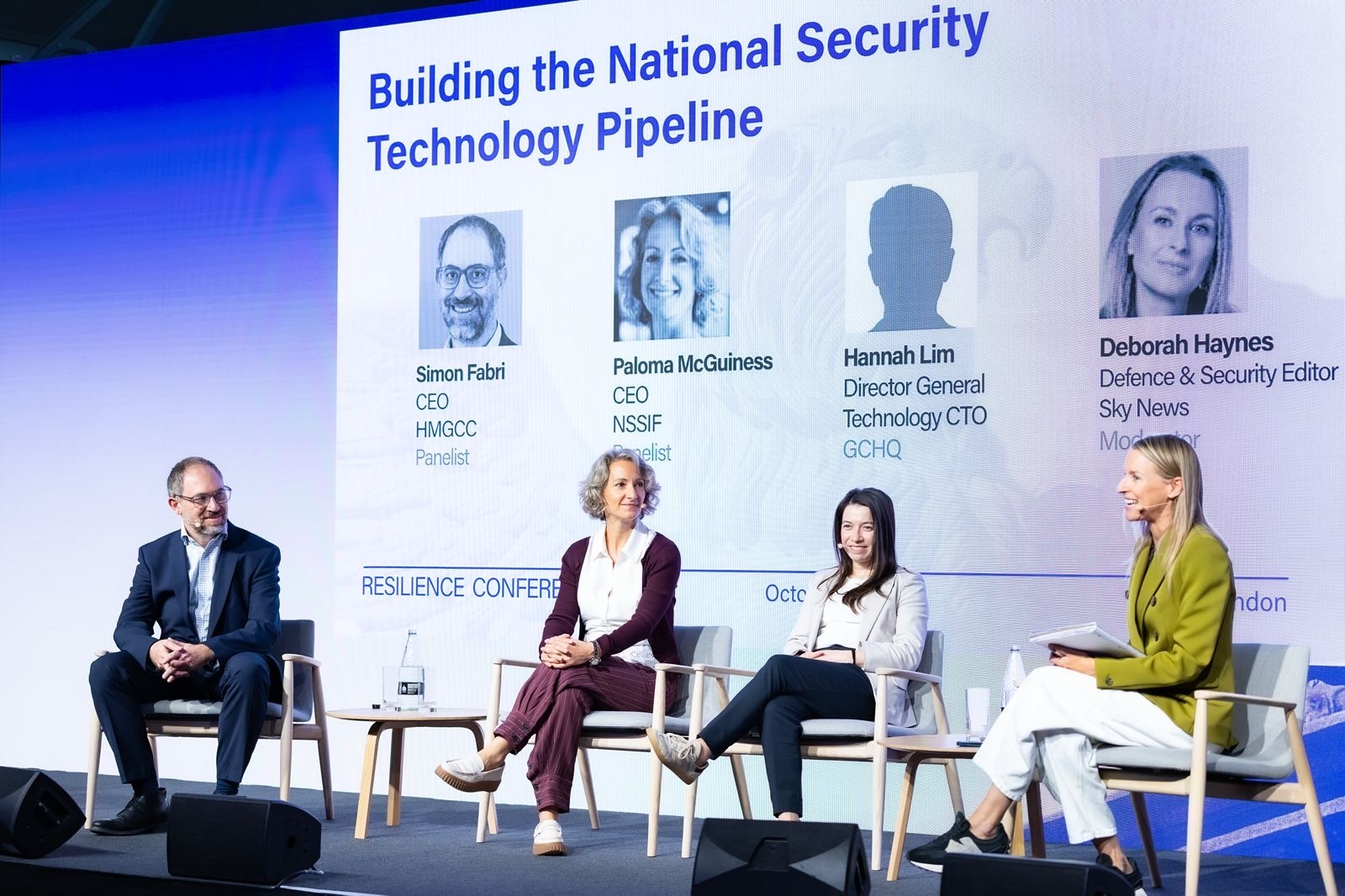
NSSIF, HMGCC and GCHQ Discuss the Power of Collaboration at the Resilience Conference
NSSIF’s CEO Paloma and other leaders from HMGCC and GCHQ joined industry leaders and innovators at the Resilience Conference this week to discuss how government, investors, innovators and end users can work together to identify, develop and scale technologies that strengthen the UK's national security.