Spotlight on Dr Stephanie Simmons: Advancing Quantum Computing Through Inclusion and Innovation
For International Women’s Day, we spoke with Dr Stephanie Simmons, founder and Chief Quantum Officer at Photonic, about what drives her at the frontier of quantum computing, and the changes she hopes to see across the ecosystem to better support women and under‑represented groups.
Dr Stephanie reflects on the importance of building inclusive environments where collaboration, communication and shared problem‑solving are valued as highly as technical expertise.
Below, Stephanie shares her insights on progress, inclusion and the future of quantum computing.
What motivates you most about the work you’re leading at Photonic?
Overarchingly, it’s the continuous progress that we’re making. At Photonic we are commercializing a branch of physics – working at the intersection of deep science and real-world impact - taking quantum ideas that have existed on paper for decades and engineering them into commercial scale, fault‑tolerant systems. That transition, from theoretical system engineering to “this actually works,” is incredibly hard, and incredibly motivating. It’s rare to work on something that could redefine what computation itself can do with direct implications for areas like drug discovery, catalysts for sustainability, and materials science.
What changes would you like to see across the quantum ecosystem to better support women and under‑represented groups?
There is an opportunity to create an ecosystem where everyone can be included, and that’s what I would like to see as the end goal. In a lot of technical training programs, and highly competitive work environments, success is based solely on individual, domain-specific competency. As a result, we often see detrimental impacts on, or at the very least, an underappreciation of, the interpersonal skills necessary to create positive working environments.
We need to shift the focus in talent development so that we are actively teaching the skills necessary for working in groups and communicating effectively, while providing opportunities to apply them. Having firsthand experience working with others as a part of a team, creating something together that is better than what any one person could create alone, is critical. We can build the types of workplaces and cultures that allow people to reach their own potential and encourage the participation and contributions of a diverse range of other people when everyone involved believes in the benefits of working together.
What role do you think diversity plays in building successful deep‑tech companies?
Like other deep tech companies, at Photonic we’re doing something that has never been done. Building a commercial-scale quantum computer is a new thing – there isn’t a pre-determined path to success, which means we benefit greatly from the different skill sets, backgrounds, experiences that each individual brings to the company.
The sheer range of the engineering backgrounds required to develop a quantum computer is frequently underestimated – there are very few branches that it doesn’t touch and that doesn’t even factor in the people we need for software, commercialisation – everything!
The diversity means that everyone brings a different lens, and a different set of operating assumptions to the table. Because we aren’t yet locked into a singular way forward, we can leverage diversity and "outside the box" thinking into a competitive advantage.
Benefiting from diversity requires a humility and openness to change that can be challenging, but if there is a unifying trait in our team, it’s that we are fearlessly ambitious, willing to take on the risks that come with forging a new path. We look for brilliant, determined people who are genuinely invested in working together to make quantum computing a reality. If you’re trying to build something that’s never existed before, you want to have a group of people who are dedicated to solving the problem, not those who are in love with their particular solution at the expense of overall progress.
What’s one thing you wish more people understood about quantum technologies?
I wish more people understood that quantum is not about a single breakthrough moment; it’s about systems, scale, and engineering discipline that takes place over decades. The real challenge isn’t demonstrating that something can work in principle, but making it reliable, manufacturable, and useful at scale.
Commercial-scale quantum computers will be transformative and may seem, to those who haven’t been working on overcoming the scientific and engineering challenges for decades, like they arrive as an overnight success. They will, however, arrive in the way every major technological breakthrough has, through years of careful design, iteration, and collaboration across science, engineering, and industry. Understanding this process helps set realistic expectations and if we’re proactive, allows us time to prepare to make the most of their potential. We’re at a pivotal time, and I hope people are aware just how exciting this moment really is.
How did you find working with NSSIF?
NSSIF first invested in Photonic in 2023, and we've built a valuable relationship with them ever since. They've been a great partner to Photonic as we have developed our plans to expand in the UK and deepened our participation in the UK's quantum ecosystem.
Photonic is an NSSIF portfolio company developing the world’s first scalable, fault-tolerant, networked quantum computer using optically-linked silicon spin qubits. Learn more about Photonic here
Related pages

NSSIF Portfolio Company ClearSpace Awarded UK ADR Mission Contract
NSSIF is delighted to congratulate portfolio company ClearSpace on being awarded the UK Space Agency's Active Debris Removal (ADR) Phase 3 mission contract.
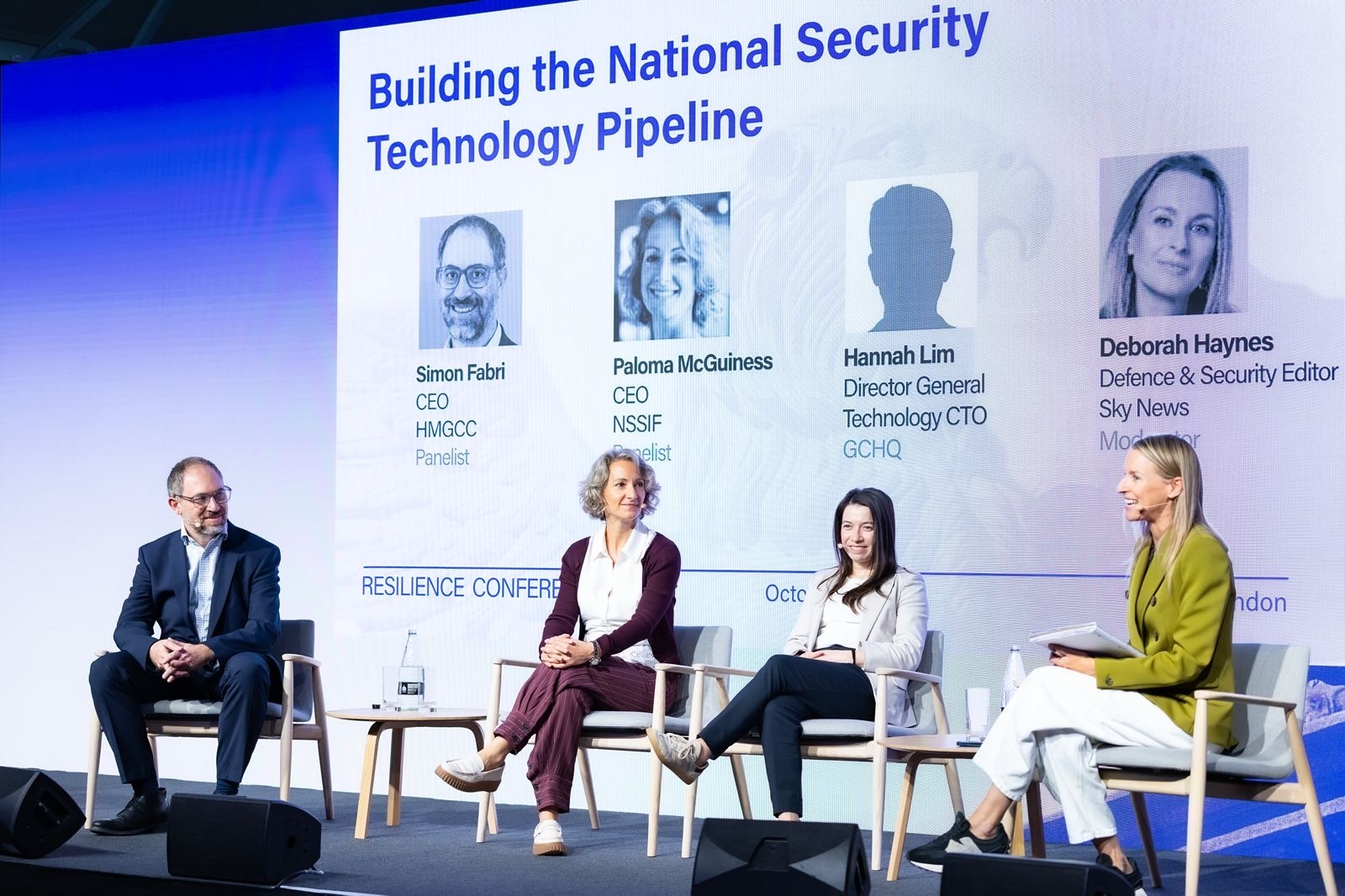
NSSIF, HMGCC and GCHQ Discuss the Power of Collaboration at the Resilience Conference
NSSIF’s CEO Paloma and other leaders from HMGCC and GCHQ joined industry leaders and innovators at the Resilience Conference this week to discuss how government, investors, innovators and end users can work together to identify, develop and scale technologies that strengthen the UK's national security.